
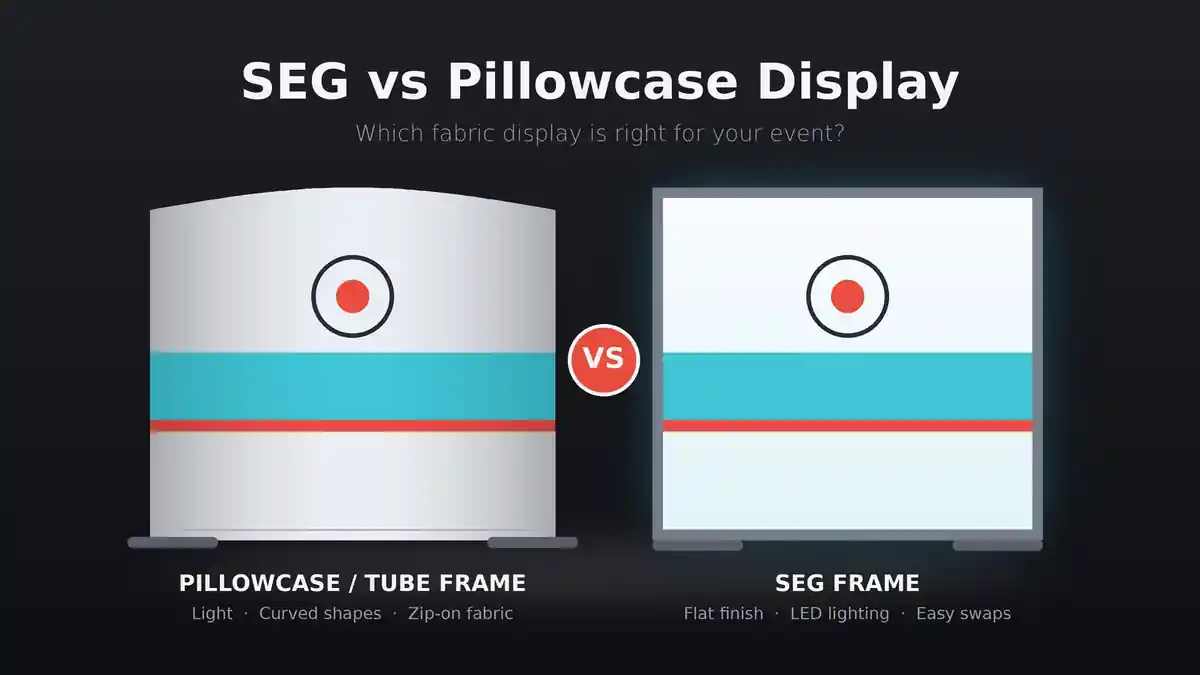
If you sell, print, or set up event displays, you get this question all the time: SEG vs pillowcase display, which one should a client buy? Both use dye-sublimated fabric stretched over an aluminum frame, both pack small, and both look far cleaner than an old vinyl banner. But they are built differently, and that difference shows up in setup time, frame shapes, graphic changes, lighting options, and cost per show.
At Display Works we manufacture and print both systems for resellers, print shops, event agencies, and exhibitors, so here is a practical, side-by-side breakdown to help you recommend the right one.
How Each System Works
Pillowcase (fabric tube) displays use a frame of connected aluminum tubes. The printed fabric graphic is sewn like a sleeve, slipped over the whole frame like a case over a pillow, and closed with a zipper, usually at the bottom or back. The fabric covers the frame completely, so the tubes are hidden and the display reads as one soft, continuous shape. You can see the range in our 10x8ft fabric tube display and 10ft curved fabric tube display.
SEG (silicone edge graphic) displays use a rigid aluminum extrusion with a narrow channel around the perimeter. A thin silicone strip is sewn to the edge of the printed fabric, and that strip is pressed into the channel, pulling the graphic tight across the face of the frame. The result is a flat, edge-to-edge image with a slim, clean border, like the 8x10ft SEG fabric stand.
SEG vs Pillowcase Display: Side by Side
- Look: Pillowcase graphics wrap the whole frame for a soft, seamless shape. SEG gives a flat, drum-tight face with a crisp framed edge.
- Shapes: Tube frames bend into curves, arches, and rounded corners easily. SEG frames are usually rectangular or square, with gentler curves possible.
- Setup: Pillowcase frames connect tube to tube and the graphic zips on. SEG frames take a little more assembly, then the graphic edge is pressed into the channel.
- Graphic changes: Both use replaceable fabric. SEG graphics are easy to swap on a frame that stays in place, which suits retail and permanent installs.
- Lighting: SEG is the standard for lit displays, edge-lit or backlit LED light boxes. Backlit tube displays exist too, but SEG has more options.
- Weight and portability: Pillowcase displays are typically the lightest option and pack into a soft bag. SEG frames are sturdier and usually heavier.
- Cost: Pillowcase displays generally cost less up front. SEG graphics cost a bit more to produce because of the silicone edge sewing.
When a Pillowcase Display Is the Better Choice
Recommend a fabric tube display when the client values portability, speed, and shape. They are ideal for traveling trade show backdrops, step-and-repeat walls, photo backdrops, and brand activations where the display is set up and broken down often. Because the frame bends, tube displays are also the go-to for curved walls, arches, and rounded-corner designs that catch the eye from across a hall.
For budget-conscious clients or high-volume reseller orders, pillowcase displays usually deliver the most impact per dollar. Our standard range runs from 2ft and 3ft banner sizes up to 8ft and 10ft backwalls, and we build custom size tube frames in widths like 12, 15, 24, and even 30 feet.
When an SEG Display Is the Better Choice
Recommend SEG when the client wants a premium, gallery-style finish or illumination. Edge-lit and backlit SEG light boxes stand out on any show floor and suit retail stores, showrooms, lobbies, and convention displays that stay up for weeks or months.
SEG is also the smarter long-term buy for clients who change their message often. The frame stays put, and new campaigns only need a new fabric graphic. Our lineup includes adjustable SEG fabric light boxes and SEG pop-up stands, and we build custom SEG frames with integrated LED lighting for larger installs.
A Simple Way to Decide
Ask your client three questions:
- Will it travel often? If yes, lean pillowcase.
- Does it need to light up or stay in one place? If yes, lean SEG.
- Is the design curved or unusually shaped? If yes, a tube frame is usually the answer.
Many exhibitors use both: a tube backdrop for the booth wall and an SEG light box as the focal point.
Frame and Print From One Supplier
Whichever system you choose, the graphic matters as much as the frame. Display Works offers in-house large format fabric printing with UV and dye-sublimation printers, so we can produce the frame and the printed graphic together, or print replacement graphics for compatible frames. Trade pricing is available for confirmed trade accounts, and local pickup is available in Jamaica, Queens, as well as delivery and shipping.
Frequently Asked Questions
What is the main difference between SEG and pillowcase displays?
A pillowcase graphic slips over a tube frame and zips closed, covering the whole frame. An SEG graphic has a silicone strip sewn on its edge that presses into a channel in a rigid aluminum frame, giving a flat, framed face.
Which is easier to set up?
Pillowcase tube displays are usually quicker and lighter: connect the tubes, slide on the graphic, and zip it closed. SEG frames take a bit more assembly but give a very tight, flat finish.
Can SEG and tube displays be lit?
Yes. SEG frames are the most common choice for edge-lit and backlit light boxes, and backlit LED fabric tube displays are also available.
Can I get custom sizes?
Yes. Display Works builds custom size fabric tube frames and custom SEG frames, including large LED SEG installations, to your requested dimensions.
Get a Quote
Still weighing SEG vs pillowcase display options for a client or show? Send your sizes and quantities to orders@display-works.com, call 856-DISPLAY (347-7529), or contact Display Works for wholesale and bulk pricing.